Mapping and Data Visualization with Python
- Level
- TODO
- Duration
- 12 hours4 sessions of 3 hours each over 2 weeks
- Prerequisites
- Python Foundation for Spatial Analysis or equivalent
Ways to take this course
This course is no longer taught as a live class. The material stays free to study on your own.
No longer offered
This course is not being taught as a live class any more, so there is no certification, support or mentoring with it.
Learning outcomes
- Understanding of the Python data visualization landscape
- Ability to explore and visualize all types of tabular and gridded datasets
- Create interactive mapping visualizations
- Build interactive dashboards and web mapping applications
Course outline
- Introduction to Python Data Visualization Landscape
- Tabular and Vector Data Visualization
- Creating charts and plots using Pandas
- Creating maps with GeoPandas
- Using basemaps with Contextily
- Raster and Gridded Data Visualization
- Raster Data Visualization using Xarray and rioxarray
- Mapping Gridded Datasets with Xarray and CartoPy
- Interactive Mapping
- Creating Interactive Maps with Folium
- Creating Multi-Layer Interactive Maps with GeoPandas
- Dashboards and Apps
- Introduction to Streamlit
- Building an interactive mapping dashboard
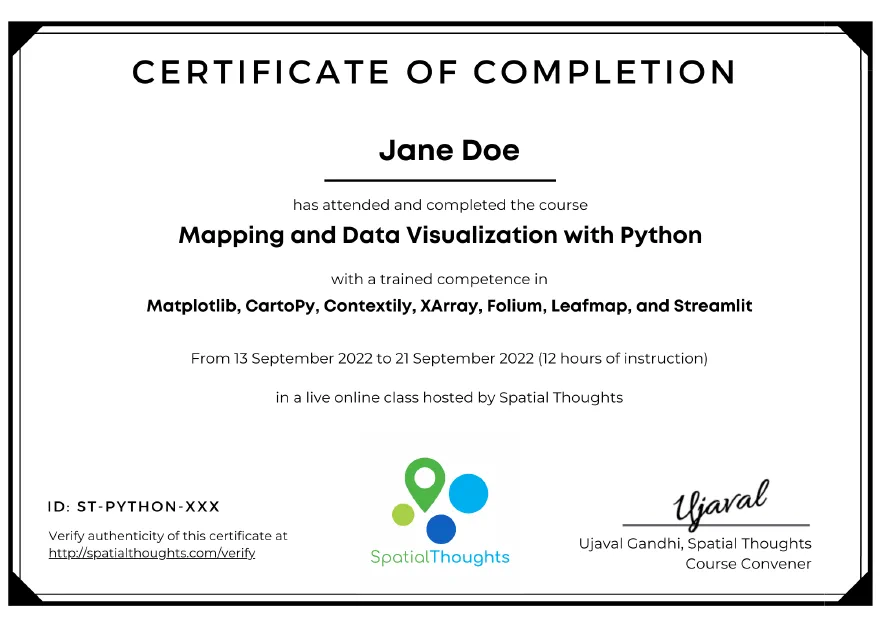
Certification
What participants say
I’ve had the opportunity to attend multiple training programs at Spatial Thoughts, and each one has played a vital role in reinforcing and expanding my skills in open-source GIS technologies. A standout experience was the “Mapping and Data Visualization with Python” course. Before the course, I reviewed the Python Data Science Foundations video series on Spatial Thoughts’ YouTube channel, which was incredibly helpful for recapping key concepts. During the course, we explored: Static visualization using Matplotlib, Seaborn, GeoPandas, and Contextily, Raster visualization with Xarray and rioxarray, Interactive mapping with Folium and Leafmap, Web app development using Streamlit to build spatial dashboards
We also explored emerging libraries like Lonboard, a powerful tool for visualizing large vector datasets. The live Colab-based walkthrough (link) was a great example of how Spatial Thoughts stays on the cutting edge of spatial visualization. The training sessions are highly interactive and learner-friendly, featuring a mix of lectures and exercises. All sessions are recorded and made available afterward, which is great for self-paced learning or revision. What I admire most is that Spatial Thoughts is not just a training provider, but a global learning platform dedicated to modern, open-source geospatial technologies. They consistently bridge the gap between traditional GIS skills and the evolving needs of large-scale spatial analytics and data-driven decision making. I continue to follow their updates and learning materials closely and would highly recommend Spatial Thoughts to any GIS professional, data scientist, or geospatial enthusiast looking to build cutting-edge skills with open-source tools.
Linda Angulo LopezSoftware Heritage, INRAE
In the age of AI and endless online resources, it might sound like a paradox, but what truly makes the difference is the guidance of an instructor like Ujaval and Vigna. That human touch is what turns learning into real growth.
Joan BauzaGeographer, University of the Balearic Islands
Ever wondered how those cool maps are made? This course has the answers. Ujaval Gandhi teaches you how to visualize spatial data using Python — from vectors to rasters. You’ll explore Matplotlib, Folium, Leafmap, and the best part? Building your own Streamlit web app with just a few lines of code. Mind = blown.
Manas Ranjan PatraStudent
Spatial Thoughts led an efficient, affordable, and valuable workshop that helped me level up in a challenging area. The resources presented during the workshop, along with their freely available technical material, make Spatial Thoughts exceptionally generous and dedicated to sharing their geospatial skills and knowledge. Highly recommend!
Joel MAsselink
Mapping and Data Visualization is in the core of many aspects in today’s world. From showing geographical spread of COVID cases to calculating distance and route optimization, the topics discussed in this course are highly useful to many people. The delivery of the course has also been exceptional and exceeded my expectations. During the course, numerous ideas have come to my mind as to how I could use some of the new knowledge for me and my company. I will definitely start implementing as much as possible. Well done to the organisers and please keep doing the same great job.
Vasileios PappasEnergy Analyst, MET International AG
Ujaval Gandhi is one of few people to whom we should be seeking help for when it comes to the spatial analysis. The way he designed and presented the class was mind-blowing. His experience and interest in teaching spatial science to people is really amazing and I recommend this course to those people who are seeking their carrier in spatial science and who has little knowledge of Python and GIS/RS. Thank you, Ujaval, and Vigna for all the support.
Lalit BCSeed Innovations Pvt. Ltd.