Table of Contents
AI Tools are accelerating how we build software. For data scientists, it means we can easily build scripts, notebooks, plugins and data pipelines for analysis. Here are some of my thoughts on what this means for you.
Andrej Karpathy, a widely respected AI researcher and educator, said something very insightful and offers a useful mental model.
“You can outsource your thinking, but you can’t outsource your understanding.”
Domain expertise matters more, not less
- If you are trying to build satellite imagery analytics for helping farmers, a deep understanding of agricultural practices, socio-economic constraints, along with the capabilities of remote sensing data is critical. The implementation of calculating NDVI from a Sentinel-2 image can be outsourced to an AI model, but knowing exactly how that data will help the farmer is important for you to understand.
- Similarly, if you are tasked with building a data processing pipeline, writing an SQL query to extract a subset from a Parquet file can be outsourced to an AI model - but knowing the use-cases and understanding of data formats is still important. For example, understanding the nuances of the GeoParquet format would be critical to design a cost-effective solution for large datasets.
- With so many new datasets being released, finding and picking the right dataset is now a core skill. All datasets have inherent limitations and you need to be able to ask the right questions to decipher the nuances. For example, Google recently released a large flood archive data called GroundSource. This is a useful data source, but unless you spent time understanding how the data was generated and evaluating it for your specific task, it is easy to misuse the data and grossly over-estimate the flood events.
Your job shifts from building to directing and validating
- When AI can rapidly generate solutions, the higher-value skill becomes identifying which problems are worth solving.
- Instead of writing code and carrying out the analysis - now your job is to guide the process. You need to identify the problem to solve, pick the right dataset, guide the model to pick the appropriate stack, and evaluate the results.
- It is making it easy to do deep analysis or work on projects that were simply too hard or would take too long. A recent participant from our Python course was able to carry out a project that used her expertise in mineral exploration and risk assessment to build a sophisticated data-driven simulation. AI-coding tools helped her build this without a lot of coding experience, but her domain expertise and understanding are what enabled the outcome.
Be deliberate about what you think about
- As AI tools get better at many tasks, you now have the freedom to choose what to think about. You still need to think deeply about topics that you care about - but at the same time, automate and outsource tasks that take up your time and mental bandwidth without adding value to your core task.
- For example, I am now using AI tools to automate tasks around running my business and streamlining logistics, which is freeing up my time to think deeply about how I can help people learn advanced skills.
- When I am working on a data analysis project, I use AI to write the boilerplate code and do data cleaning, which allows me to spend more time handling edge cases, validating assumptions, and thinking more deeply about the problem itself.
AI raises the value of your domain expertise and judgement. The nitty-gritties of implementation can be outsourced, while your focus should be on developing a deep understanding of the problem space.
UPDATE: July 2026
This underscores the need for us to have deep domain expertise and be able to critically evaluate the results.
UPDATE: August 2026
The part that I have come to believe is that AI tools allow us to solve problems more deeply and completely than ever before, so we must aim high, go deeper, learn broadly, connect ideas, and think long-term.
UPDATE: September 2026
I read David Kiss’s A eulogy for the software engineer post and several points hit home. He describes how the process of building software has changed and the traditional method of writing code has given way to validating AI-generated code.
He describes "..That’s the job now. You go all the way in until you understand the problem well enough to know a right answer when you see one. You write down what done looks like before anything gets built."
This goes to my point on developing a deep understanding of the problem so you can validate the results. What everyone is concerned now is how one develops this intuitive understanding without going through the process yourself. I have been teaching our course participants to use AI responsibly - and ensuring you spend the time you saved coding - and use it to go deeper into the problem and understand the nuances.
He also makes the point about teaching and sharing. "…But it used to come bundled along with the hard way, and the hard way is optional now, so somebody has to hand it down on purpose..". For those of us who developed these skills the hard way - we must ensure we spend the time teaching and documenting these for others. I am conscious about this and trying to create more open content around this topic - like our Agentic Coding for Geospatial course - sharing how we approach problems through the lens of someone who has worked on these before AI.
UPDATE: October 2026
Sean Goedecke’s LLMs reward expertise article echoed my earlier thoughts on importance of domain knowledge. He argues that The most important skill in prompting is expertise in the domain you’re prompting for.
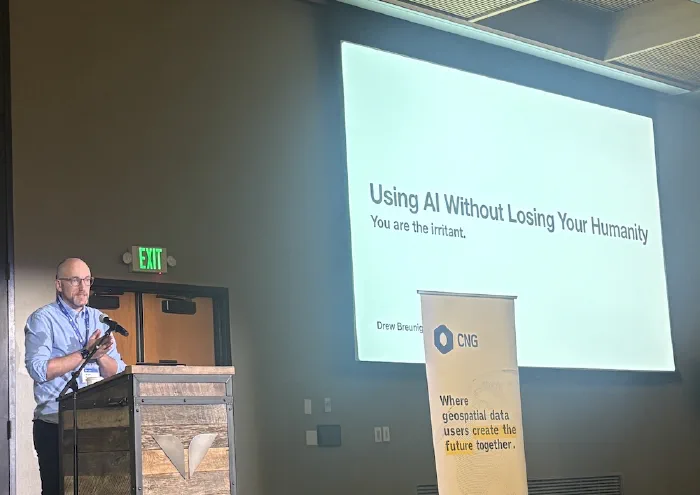
While attending the CNG Forum 2026, the closing keynote Using AI Without Losing Your Soul also argued a variation of the importance of domain knowledge, if you do not describe exactly what you want - you get the generic average result. We must push the model out of the average - to realize our vision.
How are you dealing with changes due to advances in AI? Do you agree with the views? I would love to know your thoughts and counter-arguments in the comments.
Comments